William W. Rowley
Class of 2026
- Chairman and Founder Healthnetwork Foundation
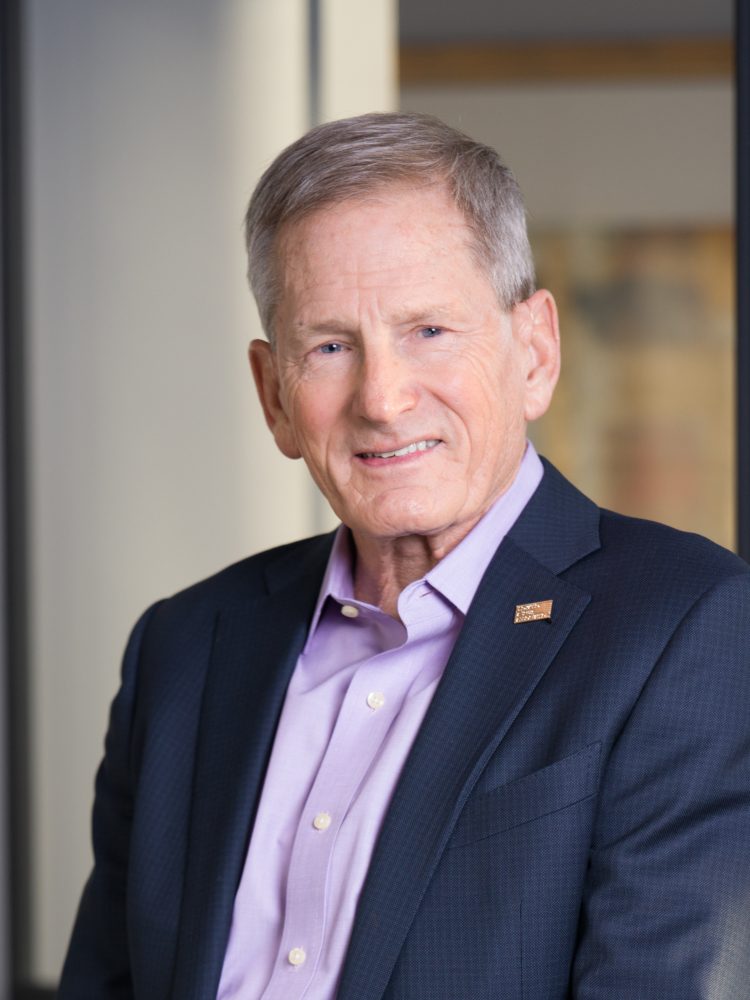
The only thing that really matters in life are the people you have helped.
Born in 1950, William Rowley was raised in an Amish community in Ohio called Middlefield. While his family was not Amish, 40 percent of his classmates were. He seamlessly went in and out of homes that had no modern conveniences, but Rowley enjoyed his simple, uncomplicated rural lifestyle. “I had a good bike, a ball glove that slid onto my handlebars, a BB gun, a basketball, and ice skates,” Rowley says. “What we didn’t have, we didn’t miss because we didn’t know anything else. I spent winters in school and summers fishing, hunting, and playing sports. I was away from the house for most of the day, but I showed up for every meal.”
Sports were a big part of Rowley’s life. By the age of 14, most of the Amish boys quit school to work full-time on their family farms. “It was rather problematic when half the sports teams left. But it was less competition for me. I grew up thinking I was a big fish in a big pond, but my life was about to change, and my eyes were about to be opened.”
When Rowley was about to start the eighth grade, his father was transferred to Mansfield, Ohio. He toured his new school and was amazed at the modernity of the campus. There was a concrete stadium, a paved track, and a gymnasium. The school had golf, tennis, and riding teams. Every sport had new uniforms. Rowley looked around with jaw-dropping awe and excitement—until he met with the athletic department.
At 5’4” and 105 pounds, Rowley was considered small. That hadn’t mattered in Middlefield, where he was a starter for every sport. But at his new school, he was turned down by the coaches for baseball and basketball. “I remember thinking this was unfair,” he says. “I had never been judged for my size before, but I finally decided that I had to follow their rules and I had to figure out how I was going to win going forward.”
Rowley went out for wrestling. He was able to start on the varsity team because the school needed someone in the lightweight category. In his first year, he wrestled 12 matches and lost all of them. By his junior and senior years, however, he had 42 wins and 2 losses. “This experience was a big lesson for me,” Rowley says. “I never blamed the coaches who turned me down due to my size. I didn’t whine or complain about the unfairness of my situation. Instead, I found a sport in which—if I worked hard—I could excel. I learned that persistence is omnipotent and is the way to winning, and that played a big part in what I did for the next 60 years in business and in life.”
A political science major, Rowley attended Miami University in Ohio from 1968 to 1972. During those years, he worked as a landscaper and cooked breakfast each day for 72 students in a fraternity house. At night and on weekends, he worked as a bartender and managed Block M, the card section for Miami football games.
Following his graduation, Rowley went to work as a salesman for his father’s Mercury Plastics company, which included four partners. At the time, the business had less than $1 million in sales and 15 employees. “Three years later, my father wanted to sell the company and suggested that I go to law school. I had a different idea, though.”
Rowley began a slow buy-out of his father and the partners. In 1976, at the age of 26, he became CEO of Mercury Plastics. He worked in every department and grew the company over the next 40 years. During that time, he attended the Harvard Business School’s Owner/President Management program, graduating in 1987 and being named Northeast Ohio Entrepreneur of the Year. In 2017, after 45 years with Mercury, he sold the company to MASCO Corporation. Rowley was now comfortable financially.
Throughout his career, he was always involved with the Young Presidents Organization (YPO). In 1991, Rowley had a vision for a venture that would lead him to a level of success money can’t buy. He created and managed the Inventory of Skills Foundation (IOS)—initially a one-chapter program that grew to include 62 chapters and 8,000 members. One of his most cherished honors came in 1999, when he received YPO’s Hickok Distinguished Service Award, the highest award in YPO. In 2000, the Inventory of Skills became Healthnetwork Foundation, a 501(c)(3) nonprofit. Rowley continues his work as Healthnetwork’s founder and chairman, donating all his time for the past 36 years. Rowley also continued to run Mercury Plastics until 2017.
Today, Healthnetwork concentrates on helping business leaders find world-class healthcare. As a nonprofit, it donates back to its physician and hospital partners to support medical research, advancing medicine for all. “This work has given me an opportunity to help thousands of people I have never met,” Rowley says. “That is my definition of success. I am very proud of all I accomplished with Mercury Plastics, but my work with the Healthnetwork Foundation truly defines who I am.”
“I built Mercury Plastics as a successful business, but what I have accomplished with the Healthnetwork Foundation is a reflection of my success in life,” Rowley says. “I knew leaders of industry who suddenly found themselves facing serious medical challenges. It became my mission to help get them connected with the best physicians and hospitals in the country. When we became a nonprofit, an amazing thing happened: The people we helped started giving back. Our members have donated hundreds of millions of dollars to Healthnetwork, our hospitals and our doctors. Helping others is the purpose of my life.”
With the hope that his legacy will be defined by his tenacity to help those in need, Rowley has advice for Horatio Alger Scholars: “The Scholars are going to be introduced to an impressive group of men and women who want to help them with their education and future careers. Additionally, the Horatio Alger Association is set up to take away as many impediments to success during their college years as possible. But it is up to the Scholars to take advantage of these opportunities. This is a rare experience that can’t be purchased. I hope that the Scholars understand this and work hard to achieve their success. The hardest working people always seem to be the luckiest.”
When asked about the power of the American Dream, he says, “Our freedom is what gives us the ability to succeed through hard work and persistence. The enduring power of the American Dream is to be able to succeed or fail based on our efforts and talent.”