Peter Craig Farrell
Class of 2026
- Founder, Chairman Emeritus and Board Member ResMed, Inc.
- Chairman Farrell Family Foundation
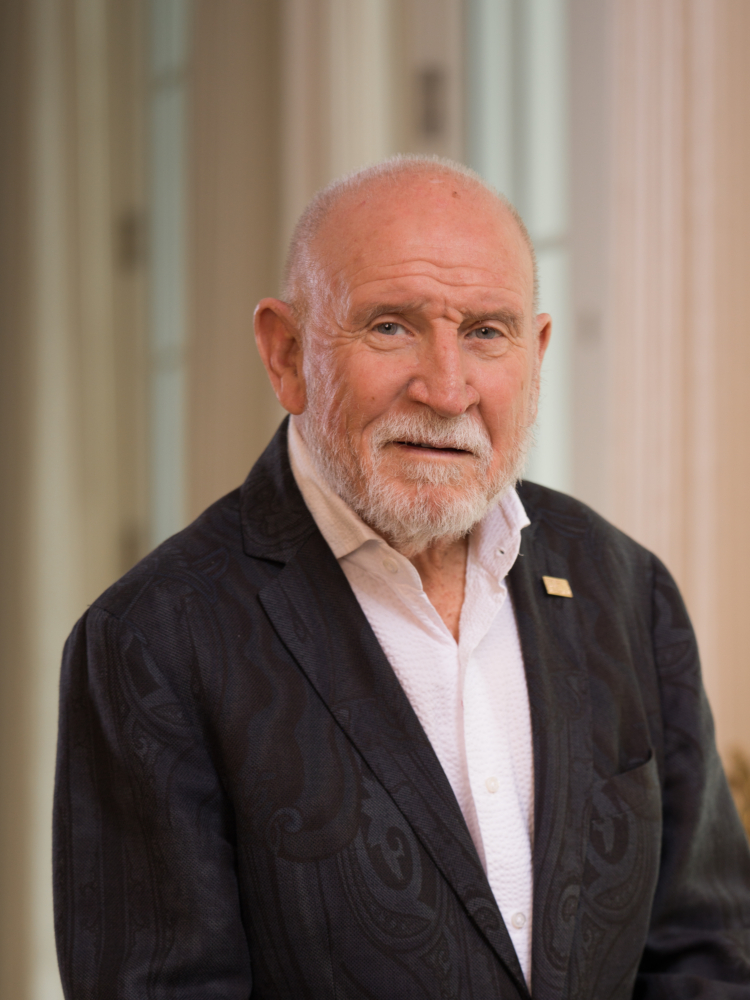
If you don’t sleep healthy, you cannot be healthy.
Farrell was a good student and did well in science and math. He became the first member of his family to attend college. With the help of a scholarship, he achieved a degree in chemical engineering, graduating with honors from the University of Sydney in 1964.
He began working in Sydney for Union Carbide and transferred to the company’s labs in Montreal after one year. While there, he noticed that most of his colleagues had advanced degrees. “I thought that If I wanted to succeed, I should get more education,” he says. “I applied to a number of schools and finally accepted a scholarship to MIT.”
After completing his MS in chemical engineering in 1967, Farrell went to the University of Washington, where he completed his PhD in 1971. In 1984, he received his Doctor of Science from the University of New South Wales in Sydney, Australia.
While earning his degrees, Farrell was blending engineering with human physiology—a combination that would later define his entire career. While holding an engineering job in Montreal in 1965, he was exposed to industrial research and development (R&D) and large-scale manufacturing environments. His doctoral work focused on cardiorespiratory physiology, especially gas exchange and respiratory mechanics. In other words, he was becoming an engineer who had an understanding of the human respiratory system.
In 1978, Farrell became the founding director of the Graduate School of Biomedical Engineering at the University of New South Wales in Sydney. During this time, he ran research programs on respiratory physiology, consulted for medical device companies, and supervised research on ventilation, oxygen delivery, and sleep-related breathing disorders.
During the early 1980s, Farrell became a consultant to Baxter International, a major medical device and pharmaceutical company. In 1981, Baxter purchased the rights to a nasal CPAP device. The company asked Farrell to assess whether the CPAP system had commercial potential. “I was impressed with the idea of this product,” Farrell says, “but the device was like a reverse vacuum cleaner attached to a Darth Vader mask that sounded like a freight train. It was difficult to put on and cumbersome, but I was confident that within six months we could produce a mask that was a tenth of the size and easier to wear. It was an untapped market, and I thought Baxter should pursue it.”
In the meantime, during the mid-1980s, Baxter sent Farrell to Japan, where he became vice president of R&D for Baxter’s Pacific region. In that position, he oversaw respiratory and renal device development. He also saw firsthand how sleep apnea was massively underdiagnosed in Asia. “This is when I realized CPAP could be a global therapy,” Farrell recalls.
In 1989, despite Farrell’s enthusiasm for CPAP, Baxter felt it was too experimental and wanted to walk away from marketing it. “I realized I could not let this opportunity go by,” Farrell says. “I raised $1 million from Australian investors and licensed the CPAP patents, thereby founding ResCare in 1989.”
ResCare had $1 million in sales in its first year but didn’t become profitable until 1992. It has had nearly 70 straight quarters of sales growth since then. The company went public in 1995, changing its name to ResMed to avoid confusion with an existing nursing care company.
Today, Farrell is a renowned figure in the medical device industry. ResMed has become the global leader in the development of cloud-connected medical devices for the treatment of sleep apnea and other respiratory conditions. He serves on several boards, including Arcturus Therapeutics, and is chairman of Wave Guide. Wave Guide is a diagnostic startup that leverages nuclear magnetic resonance technology developed within Harvard’s School of Physics. He is also a Trustee of Scripps Research at the Jacobs Engineering School at the University of California, San Diego.
Farrell was named San Diego Entrepreneur of the Year for Health Sciences in 1998, Australian Entrepreneur of the Year in 2001, and U.S. National Entrepreneur of the Year for Health Sciences in 2005. In 2010, he was named chairman of the Executive Council of the Harvard Medical School Division of Sleep Medicine and served in that capacity until 2013.
Peter Farrell’s career stands out for transforming the area of sleep medicine, building a multi-billion-dollar medical-device company, advancing biomedical engineering education, and shaping global health innovation. His impact spans industry, academia, and philanthropy, with accomplishments that changed how the world treats sleep-disordered breathing.
“I’ve given talks on college campuses about innovation, entrepreneurship, and leadership,” Farrell says. “Many people associate entrepreneurship with taking risks, but I think it has more to do with taking the opportunity when it presents itself. You do it because you are an opportunity seeker.”
A strong supporter of education, Farrell says, “Education gave me my career. I’ve seen what it has done not only for me, but for my children. It takes those who seek it to the next level. I am privileged to be able to help those who seek it but can’t afford it.”
When advising those who are just getting their start, he cautions against thinking money leads to happiness. “Personal responsibility and accountability are the best ways to save a person’s esteem.”
Farrell continues: “There is no roadmap that tells you what to do. There is no magic formula to be successful. That’s why education is so important. It prepares you for the opportunities that will come. I also believe it is vital to surround yourself with good people and train yourself to be a good listener.”
Farrell was influenced by his grandfather, who was an entrepreneur who owned an electrical engineering and contracting business. “I remember sitting beside him in church and watching him give an extremely generous amount of money when the collection plate was passed. That greatly influenced me.”
The Farrell Family Foundation (FFF) was primarily established to support community, youth, health-related causes, and education, with an emphasis on technology. More than 70 organizations have benefited from the foundation’s support. Establishing The FFF resulted in Farrell becoming a Member of the Order of Australia. He says, “One of the most important gifts I could instill in my children is the knowledge that a true sense of satisfaction and fulfillment is achieved through giving back to the community. Giving is a responsibility and should be done thoughtfully and carefully. My wife, Tama Lundquist, and I see gift-giving as an investment in the future.”